
Abstract links to Jane Austen in the South Downs
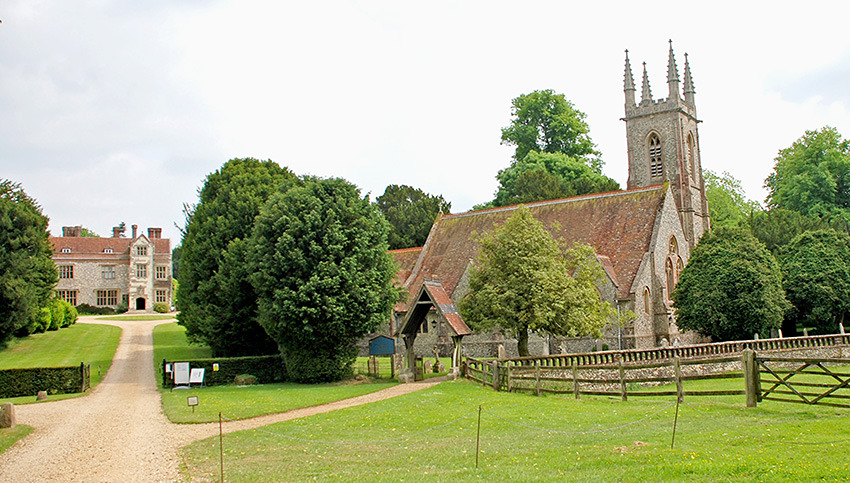
When you look at 273+ churches etc. unexpected ponderings and insights get to be worth exploring a bit. In my book on the churches of the South Downs National Park, In their Landscape, a number of different themes have been thrown up. This piece is about connectivity and thoughts about places in the South Downs National Park that relate to Jane Austen.
When we were first visiting the churches, my late husband and I knew that Chawton, the church there was one that Jane and her mother and her sister, both Cassandra Austen, attended so that was and expected connection. Alton and nearby is also known as ‘Austin Country’, but it came as rather a surprise to discover that little places, some names, some characters don’t get much attention from commentators but exist in the Park.
Throughout Jane Austen’s books, she used a lot of different names that appear to link to places that she knew and people that she knew or people that she’d come across. A lot has been written on this. Some of this piece represents my abstract thoughts, not necessarily directly related to what she did, but some may be a bit closer.
For example, Miss Taylor, who was soon to be Mrs. Weston in Emma. There was a character in West Sussex, Sir Charles William Taylor. He was a close friend of the Prince Regent, part of the debauched Carlton House Set, and he owned land south of Tuxlith Chapel next to the Victorian Milland Church. Taylor was from Hollycombe, which was an estate in the woodlands to the north of Linch. He had built it in 1800 to designs by John Nash, the famous dandy, when he was companion to the Prince Regent. Taylor is a common name, but it is interesting that it crops up at Tuxlith and Linch.
The surname of Knight was a family name. Could this have been behind Knightley?
At Warnford we come across the presence of a real Lady Catherine de Burgh, although spelled differently. The real one was ‘b o u g h’ not ‘b o u o g h’ and she was born well after Jane Austen had died, but the name was well known locally.
In 1754, John Smith de Burgh, 11th Earl of Clanricarde of Ireland bought the estate at Warnford. He had been called Burke until two years before, but he wanted to sound more Norman-Irish, so had changed the family name to de Burgh. He called the house he built there Belmont and embellished it and the park with fashionable features, as well as turning St John’s House into a scenic route.
Initially I had thought that St John’s house was some sort of Priory thing or something, but actually it was a family called St John that had owned the area before the build of Belmont. de Burgh diverted the river, to create a loop lake with sluices and Capability Brown is rumoured locally to have been involved and water management was a feature of his work. Ulick de Burgh, who was to inherit West Dean also was born in there in 1802. He was a child in Jane Austen’s time (but his father was obviously not!). Ulick became the first Marquess of Clanricarde, Postmaster General and Ambassador to Russia. So, they were a very high-profile family. Was his daughter Lady Catherine named after an earlier Lady Catherine? It is not impossible. But anyway, it’s a nice link to have the same name as an interesting fact nugget.
Mrs. Smith in Persuasion has links to Sutton and Bignor, because the Reverend Richard Smith, who was the rector of Sutton and Bignor, had as his aunt the poet Charlotte Smith, who had grown up at Bignor Park. Charlotte was very popular in her day and known to have been read by Jane Austen. People think that Mrs. Smith, in Persuasion, had had a very similar life story to that of the unfortunate authoress.
Reverend Smith and his family that Charlotte married into were slave owners. She was very anti-slavery, passionately so. But she did rely on the slave money for her ability to look after her 12 children. It wasn’t a happy marriage.
We’ve also got the Henry Smith Charity, which is now a Foundation. It was established in 1628 through the legacy of Henry Smith, who was a London businessman, and he dedicated his wealth to support people facing hardship. But at Alfriston, the Henry Smith Charity owned, or was down in the apportionment as owning, the land on which the church stood and the field next to it.
I think it’s amazing to have a really high-profile charity that still gives large sums. On its website, it says 62 million was granted last year. It was founded in 1628! Isn’t that one of the best things to do? But was Miss Smith in Emma a charity case in a nod to Henry Smith? It is interesting to explore ideas even if they will get rejected.
Kilmeston in 1775 had a rector, and at Hinton Ampner, a Reverend Edmund Ferrers, and that seems to tie in with Edward Ferrers in Sense and Sensibility. Ferrers was the rector of ‘Cheriton with Kilmeston Chapel’ later on, from 1780 to 1825, very much the period that Jane was around.
Jane Austen’s Life
Jane Austen was born in Steventon in Hampshire in 1775, daughter of the rector Rev. George Austen (who had been given the living by Mr and Mrs Knight - Mrs Knight was a cousin from Brighton who would later adopt Jane’s brother Edward Austin as their son). In 1805 Rev. Austen died, leaving his wife and daughters in difficulty until Edward Austen inherited the lands of Godmersham in Kent and Chawton in Hampshire and was able to let his family live in the house that is now the Jane Austen House museum. Jane lived there from 1807-1816, sadly dying in 1817 in Winchester and is buried in Winchester Cathedral. Most of her books were completed in those years in Chawton, although several had been drafted many years earlier. Edward Austin changed his name to Knight in 1812, to honour his benefactors after their deaths and to keep to the terms of Mrs Knight’s will.
In Chawton, Jane’s mother and her sister, both called Cassandra, are buried to the south of the church, side by side. Jane herself is in Winchester Cathedral. The tithe map was dated 1838, and Cassandra, Jane’s sister, was shown as still living in their house. Reverend Charles Knight was rector from 1837 to 67, he was one Edward’s sons and of course a beloved nephew of hers. He was also curate of West Worldham and is buried in Chawton churchyard near his aunt and grandmother.
Soon after Charles started at Chawton, his brother, another Edward Knight, started to go in for an ugly church rebuilding scheme of 1838. An ambitious heating scheme was put in by another in 1871, which led to a fire and the destruction of the nave, triggering the second better rebuild, designed by Sir Arthur Blomfield. The main look of the church is not how it would have in Jane’s day.
In Tillington, just south of the church, is what was once the rectory, and it has had a few names, starting with Old Rectory, including Lantern House and Aumonier House, built after 1816, when the Reverend James Stanier Clarke, friend and librarian to the Prince Regent, later George IV and author of The Life of Nelson, was the rector until his death in 1834.
Rev. Clarke was the correspondent and tour guide for Jane Austen’s visit to Carlton House, and he was the one who arranged for Emma to be dedicated to the Prince Regent, which was a very important thing for her and her publishing history.
Then we’ve got Clayton, not quite in East Sussex, but not far off. The major landowner at the time of the tithe map was William John Campion, lord of the manor of Clayton. He lived at Danny Park in Hurstpierpoint, there was no manor house in Clayton (the one that’s called Manor House now was actually a subsequent rectory). Campion was married to another Jane Austen, who was ‘the’ Jane Austen’s second cousin. Her grandfather was the wealthy relative who had educated young George Austen when he was orphaned, opening up his prospects as a clergyman.
And finally, Farringdon. Rev. John Benn was rector from 1797 to 1857. His younger sister, Mary Harriet, was a good friend of Jane’s and she would walk south from Chawton to visit for tea, and Miss Benn was a regular visitor to the Austens at Chawton
I think the most unexpected thing that I came across is the Tillington connection with the rector and Emma‘s dedication, although the Charlotte Smith connection is a close second, at least for me if not for others.
But there’s also all the extra things, like the names and the people and the de Burghs and the Smiths. Jane Austen actually is woven into the whole western area of the Downs. And of course, the tithe map information for the 1830s is only just over 20 years after she died. So that all the things to do with the rectors, the vicars, the curates, they had lives very similar to the lives that she described in her books, including Mr Collins or Mr Elton or others like them.
As a final comment comes the medieval village of Wickham. It is interesting to ponder upon what made her choose the name for the dastardly character in Pride and Prejudice. It works so well to say it out loud. I once used a map to choose a name for a stuffed mouse I bought in Scotland. I soon found the name Drumnadrochit and he has kept that name since. I do not believe it was the result of a pin!
Wickham has the church just outside it, and on the tithe map it is shown cut out of the town, which is a bit strange. It is a fine if a bit confused originally Norman church as well, on a prehistoric mound.
Thanks for reading!
Comments