
Rev. Gilbert White and his complex family tree
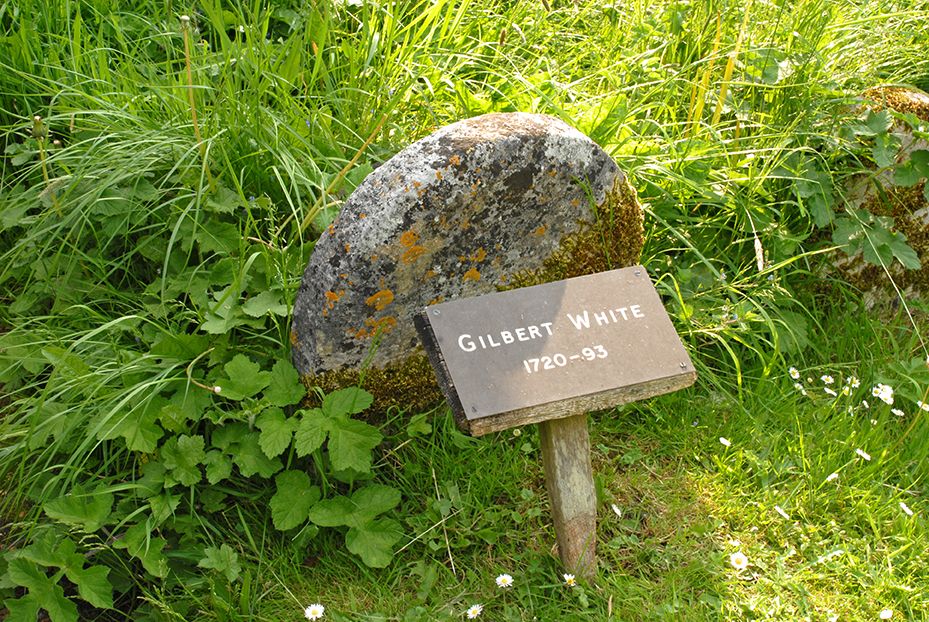
This is another instalment in my exploration of themes that have come up as a result of working on the churches, chapels and places of worship across the South Downs National Park (for In their Landscape). 273+ of them means that there’s a lot of repeating themes that have come up.
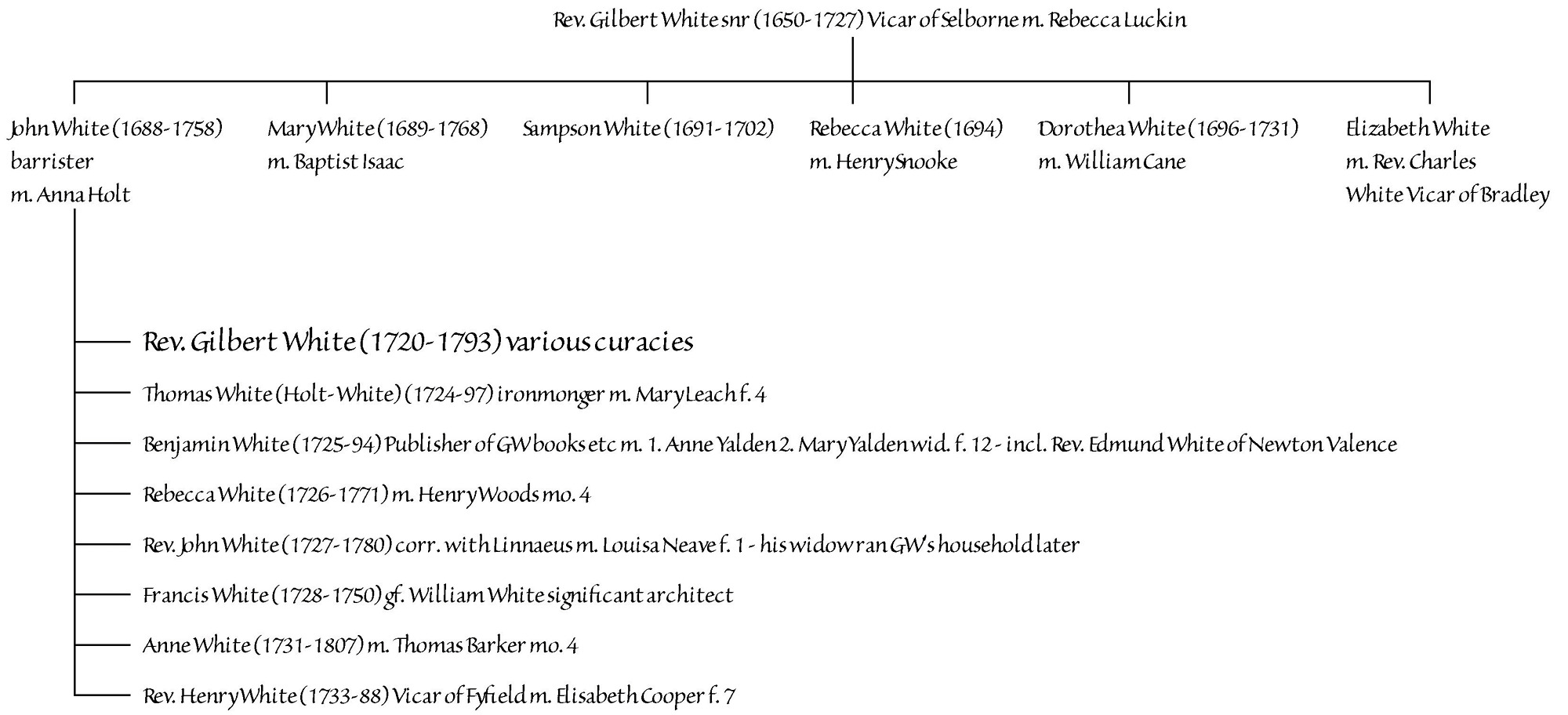
In this, I am looking at Rev. Gilbert White and the number of times that he cropped up. These drew attention to the complexities of his family tree, which came as a bit of a surprise (although I suppose all or almost all of the themes are a surprise).
So, Gilbert White is famous for his book, still in print, The Natural History of Selborne. Obviously, the main village associated with him is Selborne in Hampshire, just south of Alton. He was born to the son of the then vicar of Selborne Church, who was also called Rev. Gilbert White in 1720. His father had been a barrister, but didn’t really like doing that, so once he got married he seemed to spend most of his time making babies.
Rev. Gilbert White senior had been to Magdalen College, Oxford, the patrons for the Selborne church. His famous grandson, as a result of the impact of his uncle Rev. Charles White, went to Oriel College, Oxford. He did become a fellow and had various other senior positions in the college during his life, but he was never eligible to be vicar at Selborne even though that’s where he really wanted to be, and that’s where he stayed, as much as he could.
Young Gilbert took on various curacies across Hampshire and other parts of the country. His family tree gets tangled up in everything that he did. And I got rather confused by it, which is why I’m now writing about it. In 1793, as a result of all his siblings having children and their children having children, he had counted in his last journal a total of 61 nephews and nieces. He had at least 32 actual nephews and nieces. But 61, that’s a big family, of which he was always proud and connected to.
Born in 1720, Gilbert was the first child of his parents, ten months after their marriage. They then had three children that sadly didn’t make it. After this his mother continued to pop out a new baby pretty much every year. It does beg the redundant question, is there some sort of relationship between somebody who’s not got much to do and the number of children he has begotten? Or is it just that because there was no family planning in those days, that’s what happened? Gilbert’s mother died in 1739 at the age of 47, having given birth at least 11 times. Eight children survived, three died.
The naturalist Rev. Gilbert White was curate of Selborne in 1751, 1756, 1758, and then from 1784 to 1793 (the date of his death). Long after his death, his great nephew, William White, whose grandfather was Gilbert’s brother Francis, was the architect in charge of the repairs to the church in 1856. He also managed to put some yew wood into the church at the same time. Then he was also curate at Farringdon from 1761 to 84, in the gap when he wasn’t curate at Selborne.
In 1757 until his death, he was given the living and another curatorial living. He never did anything, as curate for Oriel College, for Moreton Pinckney in Northamptonshire. And he never lived there, whether he ever went there, I don’t know. His predecessor also had not spent time anywhere near Moreton Pinckney. It was something that Oriel seemed to be quite happy about.
Early in his career (albeit that this is outside the National Park, but it has been quite a relevant one to have included for a number of reasons, not least because it’s in a chalk area). The photo is of Northington Church, the Victorian one that’s soaked up the congregation that would have attended the neighbouring Swarraton church. Rev. Gilbert White was the unlicensed curate in 1747 for his uncle, Rev. Charles White. And trying to work out Rev. Charles White got a bit complicated because he was married to Gilbert’s aunt Elizabeth. Elizabeth White was his father’s sister, but she was married to Rev. Charles White, who was the only son of a Charles White, and he was at Bradley, paying to have Gilbert do the curacy, because he was busy at Bradley.
The Wakes in Selborne is a famous property, now known as the Gilbert White Museum. It was bought by Rev. Gilbert White, snr. Gilbert’s grandfather when he realised his wife would need a home when he died. Young Gilbert lived there as a child with his grandmother. Then she died. He went back to his parents and then they all came to live there themselves, although it had been inherited by his father’s sister Elizabeth. After her death it was up to her husband Rev. Charles White, who left it to Gilbert.
It appears that it is likely that Charles White was some sort of relative, but, it doesn’t look as though he was a first cousin. That was a bit of a tendency for first cousins to marry in those days. There was another White:White intermarriage among his nieces and nephews. A niece was married to her first cousin, a nephew, and her father-in-law was her uncle.
In Hawkley, brother Benjamin’s son, Rev. Edmund White, looked after the earlier chapel from 1788. And in the journals, he was referred to as Mr. White of Newton, because he was also the rector at Newton Valence. There was also a dramatic landslip at Hawkley Hanger mentioned in the 1774 journal, ‘torn from its place and fell down, leaving a high free-stone cliff naked and bare, and resembling the steep side of a chalk pit’.
Gilbert didn’t like the roads around West Worldham. He didn’t like many of the roads, as like Cobbett, who also didn’t like many of the roads. Locally, the smaller roads are still quite narrow, and a lot don’t seem to go anywhere particularly intentionally.
Then, for Oakhanger and Blackmoor Gilbert mentions chapels that are now gone that had been part of Selborne Priory. In the 18th century, they had already gone and archaeologists still haven’t really located where they were.
As well as the siblings and the nieces and nephews, Gilbert also had five aunts and uncles. In Ringmer comes Timothy the tortoise. His aunt, Rebecca Snooke, lived at Delves House, which is now a retirement home. A building is still there. This was where she lived with her husband and Timothy, the tortoise, with whom Gilbert was transfixed. There are plenty of entries in his journal that talk about things to do with Timothy the tortoise, including trying to see if he would swim. And he didn’t. He sank. Aunt Rebecca got him from a sea captain in Chichester in 1740. When she died, Gilbert took Timothy and ‘he’ lived for a year longer than Gilbert. After ‘he’ died, it was discovered that he was a she…
Comments