
Unexpected Cricketing History!
When I started to write the book 'In their Landscape: the churches, chapels and ruined places of worship in the South Downs National Park’ the history of cricket wasn’t anywhere close to any sort of Bingo card for the extra topics that might show up. Arguably, that was a little naive of me as Sussex and Hampshire have been strong on cricket for a long time, but not obviously church related.
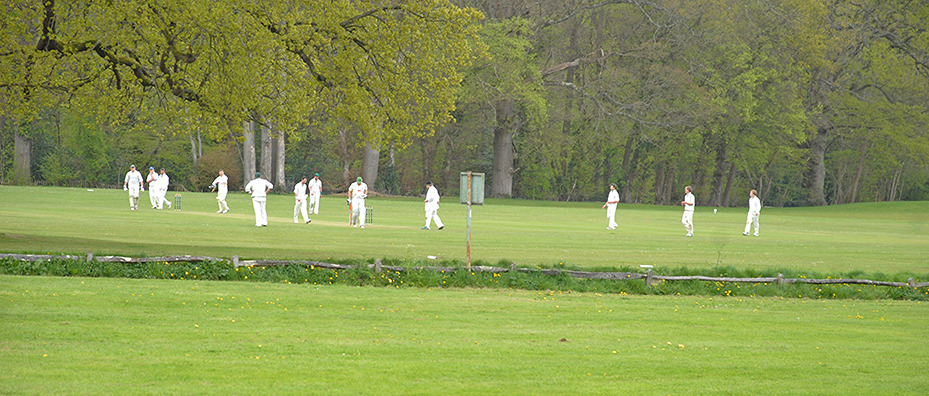
The classic image of the tourist attraction English village has a church with a tower and/or spire, with a clock and a green nearby where villagers play cricket in the summer, with sounds emanating from chimes and thwacks and gloved-hand clapping.
We saw actual cricket matches opposite the churches in Lurgashall and Fernhurst, although the glove-handed onlookers seemed to be absent, but the researches into the individual churches across the National Park threw up some key points in cricketing history and that was the big surprise and joy.
Boxgrove Priory
Founded in 1117 the priory church became the parish church after the Reformation/Dissolution of 1536. The churchyard has one of the first records of cricket in Sussex (the first was Sidlesham 1611). The game as it was at the time was being played in the churchyard by several parishioners in 1622, for which they were prosecuted (hence the record). It appears that cricket had grown up as a way of jazzing-up bowls by introducing a bat, more in the shape of a rounders bat than the way it looks today, starting in medieval says and evolving. In 1662, churchwardens playing in the churchyard were in trouble after nearly killing a small child, plausibly by double-batting, which was already a problem that had killed fielders. Bowling at this point was underarm, which was slower, and if the batsman wasn’t happy with his first attempt the lack of speed allowed for another go before it had moved out of reach. Fielding close to a batsman prone to this was very dangerous! It got banned.
Hambledon
As cricket continued to evolve, the informal village game became more structured and local groups started to build and the game spread out from its origins in Surrey, Kent, Sussex and Hampshire into London. The village of Hambledon is famous for its 1750 cricket club, the first of its kind and the most dominant, where many of the major cricketing rules were formalised before the Marylebone Cricket Club (MCC) was founded in 1787.
West Meon
Thomas Lord is one of the major names that still ‘means’ cricket to many. He was the man who chose the land that is still used by the MCC today. He was a cricketer and groundsman, later a wine merchant, for the MCC and selected three sites for their grounds after being asked to do so. The first site, which is now under Dorset Square, was one they used for many years until the rent increase upset the groundskeeper and he arranged for the turf to be pulled up so that his gentlemen could play on the same grass at the second site. This by then was the time of the Napoleonic Wars and cricket in a new site wasn’t uppermost in their priorities. After about three years the need for another new site was confirmed by the plans to cut the Regents Canal through the grounds, not great for playing the game! Up came the turf again and the third site reflected a better choice given that the MCC have been there for over 200 years.
Lord lived his last two years in the village of West Meon and is buried in the churchyard (d.1832) near the site of the old church. It is a large tomb. Tsk about the lichens, though. The tomb when we visited the church was covered in a patina of lichens, but last December (2025) the MCC got all excited and the tomb is now extremely white! The problem is that due to the symbiotic nature of lichens this is not the wisest action to have taken. Lichens are a fascinating relationship between a fungus and/or alga or cyanobacteria, probably with some yeasts, where they exchange activities to their mutual benefit. If this relationship is broken then the filaments of the fungus get distressed locked into the surface of the stone and it can start to crumble. To protect the surface, the lichens need to be left to enjoy life!
West Lavington
Early cricket pitches were often cleared from open common and at the Victorian new settlement of West Lavington, near Midhurst, the 1839 tithe map shows a circular cricket pitch in Woolavington Common before the church and presumably the settlement, were founded in 1850. The common was then owned by Pruett Dennett, who was presumably a cricketer. By 1900 the pitch was already growing over and is now just open ground hemmed by trees, it seems that these villagers haven’t taken to the game particularly.
Hurstpierpoint
The builder of the 1843 church that was a rebuild of an earlier one was Thomas Wisden, who was the father of the famous cricketer John Wisden, of Wisden’s Almanac.
Swanmore
The church was a new site this time, built in 1844 as a chapelry of nearby Droxford. It is likely that Bettesworth Pitt Shearer, who lived in Swanmore House, was involved, since he had donated land for Swanmore church on the Isle of Wight and had founded the Hampshire Swanmore’s cricket club and chaired the Highway Committee. This link will not have been an unusual one in village histories.
Duncton
The village of Duncton rises up from the bottom of Duncton Hill. It has the Cricketers Arms pub, which was once owned by John Wisden (who bought it in 1867) and run by his fellow bowler, Jem Dean. Jem Broadbridge was an earlier batsman also from Duncton and he is buried in the old churchyard at the bottom of Duncton Hill. There is a Victorian church higher up that replaced it, the villagers had been living on the higher ground by then. John Wisden (1826-1884) had launched his almanac in 1864. He had stayed in London when at the start of his career with Tom Box, who had played with both Jem Broadbridge and William Lillywhite, famous cricketers of the previous generation.
This is where the bowling question crops up again, I suppose, because by their time the underarm bowling had been jazzed up by what seems to me a bizarre style, but a bit faster and by then ‘allowed’ by the rules. Round arm bowling apparently involved the bowlers jutting their arms out at 90 degrees to throw the ball. I think by then the bat had grown into more like the modern bats, made of willow so the thwack sound would have been more prominent.
Preston Park, Brighton
There was a short-lived International Gun and Polo Club in the fields east of the church by 1876, but it was a cricket pitch by 1896.
It all just goes to show that ‘you never can tell’!!
Comments